
1983 World Cup Victory: How India Created Cricket History

The 1983 World Cup victory is still among the most important moments in cricket. The team was not thought of as the main guys to win at the start of the competition. Most of us didn’t believe they would smash everyone and win the cup. Still, the team did everything they could and arrived at the tournament at Lord&039;s. Winclash is still a wonderful cricket story of resiliency, teamwork, and belief against hardship.
The competition took place in England and Wales. Eight teams were engaged. Strong opponents and difficult playing conditions confronted the squad. There were also a few setbacks along the route. The players, however, did not let those results influence their next match.
Later on, the victory defined Indian cricket history. It demonstrated that the best on paper need not always define a squad. Good cooperation and the correct attitude can occasionally change everything.
1983 World Cup Victory and the Emergence of a Fresh Team
The 1983 World Cup victory followed a demanding competition. The team advanced to the next level after winning four of its six group matches. Two more losses were also experienced. Thus, the path to the championship was challenging.
The players were still going strong, though. Every match offered them something fresh to learn. A few players raised the bat. Others differentiated with their ballwork. Important events happened to the fielders as well.
The trip of the 1983 World Cup victory was greatly influenced by that. It was about one player not doing everything. Several players rose to the occasion at different moments.
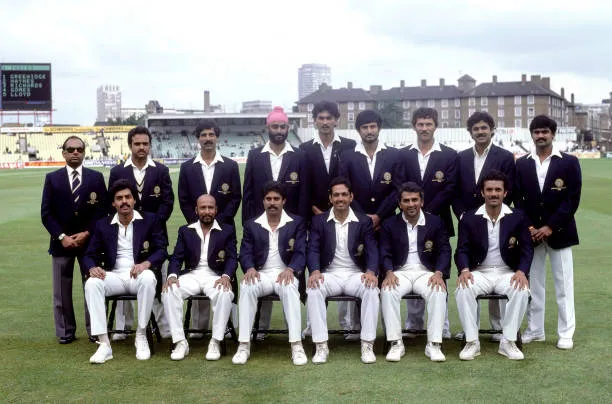
Kapil Dev's leadership established the mood.

Kapil Dev’s leadership was central to the campaign. Though he was the captain, he also made a significant contribution with bat and ball.
Over the competition, Kapil claimed 12 wickets and made 303 runs. These data reveal his level of contribution. He could score fast when the team needed runs. When they needed wickets, he could ball it out and get things done.
More than that, he boosted the team’s morale. When matches got tight, his approach counted. Closely related to the team’s ascent during the event is the story of Kapil Dev’s 1983 World Cup victory.
Journey Changes: Kapil Dev 175 Not Out
Among the most important events was Zimbabwe’s game. Losing five wickets for just seventeen runs put the squad in great difficulty. Then Kapil assumed control.
From 138 balls, he hit Kapil Dev 175*. He hit sixteen fours and six sixes in his innings. He helped the squad to get 266 for eight. The squad next bowled Zimbabwe out for 235 and triumphed by 31 runs.
The timing of Kapil Dev’s 175 innings made it unique. When he began attacking, the team was virtually out of the match. He carried the game to the opposition rather than giving up.
That victory really encouraged the team a lot. Additionally, as the competition developed, it boosted the players’ confidence.
1983 World Cup Victory: The Road to Glory
The semi-final marked yet another significant phase of the 1983 World Cup victory and tournament journey. At Old Trafford,the team took on England.
The bowlers limited England to 213 runs and did a fantastic job. Then the hunt moved in India’s direction. The game finished in flair thanks in part to Sandeep Patil’s 51 off just 32 balls.
The squad made the championship match after winning six wickets.
One game separated the trophy now.
India vs West Indies 1983: An Exact Conclusion
On June 25, Lord’s hosted the India vs West Indies 1983 final. The first two World Cups had already been won by the opposition. This game was not going to be easy.
First batted but fought on the side. The innings finished at 183 in 54.4 overs.
Kris Srikkanth hit 38 runs. Mohinder Amarnath added 26 and Sandeep Patil 27.
A score of 183 didn’t seem particularly high. The opposition had a great line-up, and many expected it to reach the target.
Still, the squad had an opportunity.
India 183 Runs 1983 Final: A Score Sufficient
Comparatively, India’s 183 runs in the 1983 final seemed modest by modern criteria. Still, the circumstances provided the bowlers something to work with.
Balwinder Singh Sandhu got the squad off to a good start. Early on, he dismissed Gordon Greenidge, which greatly encouraged the bowlers.
Viv Richards then entered and began attacking. He made 33 runs and seemed prepared to lead the pursuit. One of the most notable events of the match occurred then.
Running back, Kapil Dev dismissed Richards with a tough catch. This was a significant wicket. The squad started to have more faith.
The bowlers then continued working. Madan Lal and Mohinder Amarnath both claimed three wickets. More wickets came next, and the pursuit started to collapse. At last, the opposition was 140 all out.
With 43 runs, the squad raised its first World Cup prize. The tale is still a classic component of cricket culture for Winclash
1983 Cricket World Cup Final: The Memorable Occasion
The 1983 Cricket World Cup final is remembered for the team’s ability to hold off the reigning champions for such a little score.
1983 World Cup victory required the whole squad to work together. Early on, Sandhu achieved the breakthrough. Kapil made the legendary catch. Then Madan Lal and Amarnath sustained the pressure.
The Player of the Match was Amarnath. He claimed three wickets and scored 26 runs. His effort was a perfect illustration of how various players showed up at different times to make a difference.
The 1983 World Cup final, which the Lord’s played, also gave cricket one of its most recognisable prize moments. The Lord’s balcony saw Kapil Dev’s leadership raise the prize. The victory came to be strongly associated with that picture.
The last was also about remaining composed. With just 183 runs, the squad had no room for sloppy errors. The fielders had to remain attentive, and the bowlers had to be exact.
That is what makes the outcome so special. No one player carried the entire squad. Every person had a role to complete.
India World Cup Victory 1983 and Its Ongoing Consequences
The India 1983 World Cup victory changed Indian cricket history as well as local views of the game. Before this competition, the squad had only won one game in the first two World Cups. Now, it was the world champion.
The win gave young players a new dream. Many children wanted to pick up a bat or ball. Fans also became even more interested in major cricket events.
The tournament also showed how important every player was. With 303 runs and 12 wickets taken, Kapil is With 18 wickets, Roger Binny ended as the top wicket-taker. Seventeen wickets went to Madan Lal.
Thus, the outcome was not only about Kapil. The entire team contributed to its success.
The narrative also ties in with the larger Indian women’s cricket history. Players and teams have produced their own significant events on the world scene over the years. Taken together, these tales demonstrate how the sport has evolved across generations.
The 1983 victory had consequences beyond one competition. It helped young players become more confident and made a World Cup championship appear like a realistic aim.
That is exactly why India’s cricket World Cup history still counts the victory as a major event.
India's Famous World Cup Win: A Model for Every Generation
People still talk about India’s historic World Cup victory because the team had a lot of reasons to give up hope.
There were setbacks. The games were hard. Then came a last wherein 183 runs seemed woefully inadequate. But the players persisted.
The most important lesson is basic. The squad that seems the best before a game does not always come out on top. Things might alter when players are concentrated and trust one another.
The conclusion had a number of those moments. Sandhu’s early wicket of Sandhu assisted. Kapil’s catch altered the mood. Then Madan Lal and Amarnath continued to apply the pressure.
One moment led to the next, the game gradually turning in the team&039;s favor.
From Kapil’s well-known 175 not out to the last catch at Lord’s, the competition offers events still much discussed now.
The 1983 World Cup victory was far beyond a trophy. For the club, it started a new chapter,r and many young fans and players were motivated.
The narrative, even yet, has a straightforward lesson. A challenging beginning does not determine how things will turn out. If a team stays together, keeps working, and doesn’t give up, an unexpected outcome may still become historical.