
India’s Domestic Cricket Circuit: Teams, Tournaments and Talent

The Pulse Inside India’s Domestic Cricket
India’s domestic cricket typically tends to exist in its own little world away from the major televised matches due to the fact that there is a lot of cricket played at smaller venues without much fanfare. However, the cricket played at these venues has a far greater impact on the development of Indian cricket than is generally known, because every run and every wicket has its significance in terms of selection.
Many young batters cross 600 runs in a Ranji season, and they do this while facing tough bowling attacks and long spells. Fast bowlers in SMAT hit speeds close to 145 km/h, proving India’s pace talent is growing across regions even though these performances rarely trend online.
Coaches and captains spot weaknesses quickly because they know how fast a small flaw can affect a match. This is the reason why one needs concentration, simplicity and confidence while playing in Domestic cricket tournaments in India.
The other thing that India’s domestic cricket helps in is coping with the silence around, as there are no spectators cheering for them. The cricketers will hear each call made by them, and this will strengthen their minds, as they need to motivate themselves. This quiet pressure shapes long careers, especially when players learn to stay calm even though the competition moves slowly.
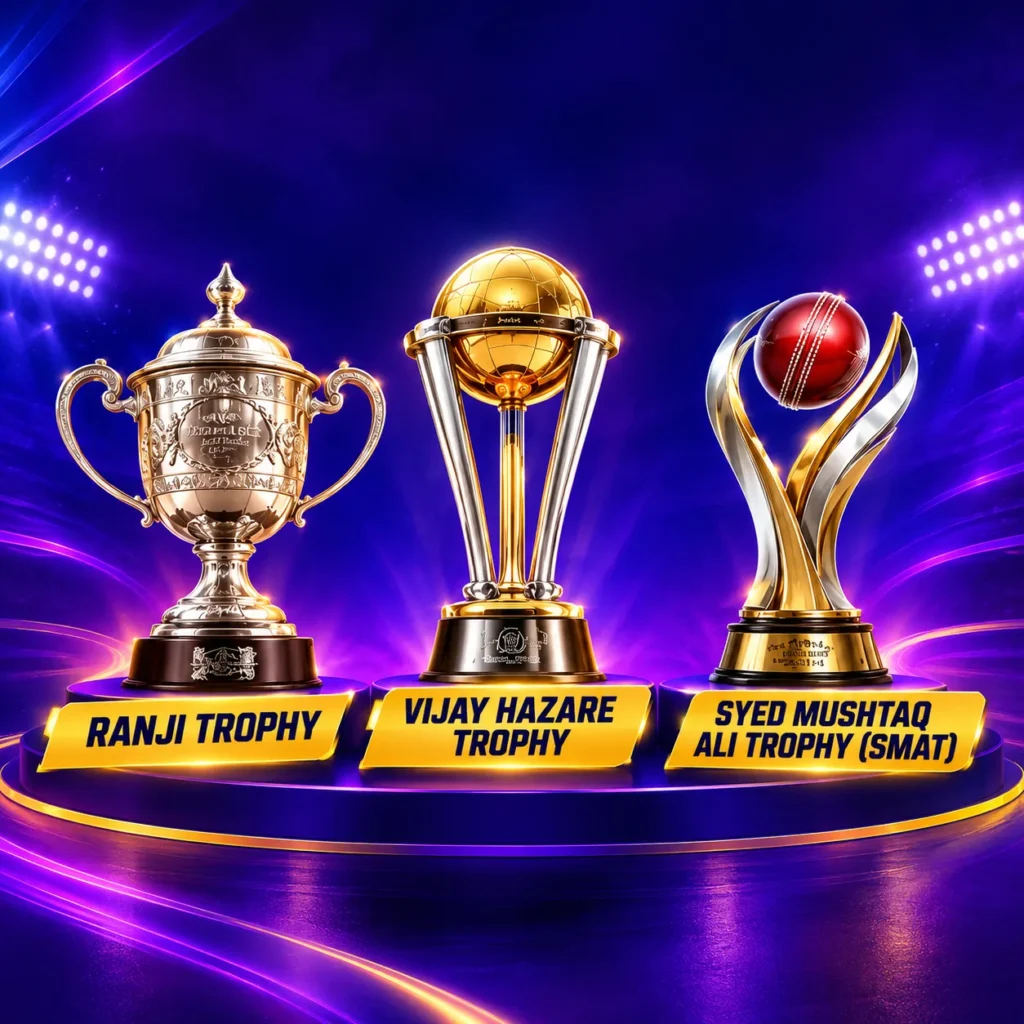
Tournament Core Focus
Tournament | Format | Main Skill Built |
Ranji Trophy | Multi‑day | Red‑ball technique and patience |
Vijay Hazare Trophy | 50‑over | Tempo, pacing, and strike rotation |
Syed Mushtaq Ali Trophy (SMAT) | T20 | Power hitting and quick decisio‑making |
Each one learns something unique, but taken all together, they shape players who have everything it takes to excel in IPL and other forms of cricket.
How India’s Domestic Cricket System Works
India’s domestic cricket system is designed to test players in different ways. Ranji teaches patience, while Hazare teaches pacing, and SMAT teaches speed and bravery. When players move through all three formats, they learn how to adjust quickly and stay calm under pressure.
Ranji Trophy — Red‑Ball Backbone
The Ranji format is the hardest format, as matches take place over several days and there is adaptation to different pitches and periods of time. Batsmen learn how to let the ball be and play for hours, and bowlers learn how to have patience and use little changes in terms of angle and length.
Ranji Stats
- First‑innings scores: 310–330 runs
- Registered first‑class players: 870+
- Fast‑bowler workload: 250–300 overs per season
In general, Ranji lays down the foundation of Indian cricket since players who excel in this category usually have good traits when moving to better levels. It also teaches players how to handle long pressure spells, especially when a batter faces the same bowler for ten overs straight or a bowler works through a session without taking a wicket.
Vijay Hazare Trophy — One‑Day Sprint
Hazare changes the pace completely. Scoring fast while ensuring protection for the wickets is necessary, and the batters understand how to rotate strike, make gaps, and form partnerships. The bowlers understand how to manage middle overs and prevent any boundary scoring, which becomes critical in international cricket later on.
Hazare Stats
- Victory totals: 280+ runs
- ODI pipeline: 36% of new ODI players since 2018 came from Hazare
- Key skill: Middle‑overs control
Hazare helps selectors see who can handle white‑ball pressure and build smart innings. It also teaches players how to plan innings, most notably when deciding when to attack or slow down.
Syed Mushtaq Ali Trophy — T20 Launchpad
SMAT is fast and intense because every ball matters. Scouts watch closely since many IPL picks come from this tournament. Batters must hit hard without losing shape, while bowlers must stay calm even when batters attack.
SMAT Stats
- First‑innings scores: 160–175 runs
- IPL conversion: 70% of uncapped IPL players are from SMAT
- Key metrics: Strike rate 150+, economy under 7.5
SMAT rewards brave choices and quick reactions, and it shows which players can handle high‑pressure moments. It also teaches players how to think fast, especially when a batter faces only ten balls but must score twenty runs.
India’s Domestic Cricket Schedule — Why It Feels Packed
Players travel across India during the winter season, and they switch formats often, which makes the schedule feel tight. One week they defend for hours in Ranji, while the next week they chase totals in Hazare, and then they sprint through T20 matches in SMAT.
Season Flow Table
Tournament | Format | Months |
SMAT | T20 | Oct–Nov |
Vijay Hazare | 50‑over | Nov–Dec |
Ranji Trophy | Multi‑day | Jan–Mar |
Switching formats is hard because batters adjust stance, timing, and shot selection, while bowlers change lengths and speeds. Weather also affects performance, especially when northern grounds feel cold while southern pitches behave differently. Good sleep and recovery help players stay sharp.
Extra matches between tournaments add more playing time, and although they help players stay in rhythm, they also increase fatigue. Managing energy becomes a big part of the season.
Players also learn how to deal with travelling because they go from one city to another, stay in various hotels, and practise on various grounds. This increases their adaptability, which comes handy for them in IPL and international cricket.
Indian Domestic Cricket Teams — The Backbone
India’s domestic cricket has strong traditional teams and rising challengers, and each state plays with its own style and identity.
Traditional Powerhouses
- Mumbai: Most Ranji titles; strong batting depth
- Karnataka: Balanced squads; steady pipeline of batters and pacers
- Tamil Nadu: T20 specialists; strong SMAT record
Rising & Surprise Teams
- Saurashtra: Disciplined seam attack; tough lower order
- Vidarbha: Back‑to‑back Ranji titles; strong teamwork
- Himachal Pradesh: Smart white‑ball plans; frequent upsets
Such teams highlight the talent distribution in India, considering that small states can produce great players who challenge traditional powerhouses.
Talent Pathways — How India Builds Stars
For player development, India’s domestic cricket has a well-defined route. Every step weeds out the weaker players and boosts confidence, and the process starts in academies and progresses to senior teams and leagues.
Player Pathway Table
Stage | What Happens |
State Academy | Basic technique; 150–200 junior matches |
Domestic Debut | First senior matches; pressure tests |
Franchise Scouting | SMAT and Hazare stats lead to contracts |
National Call‑Up | Selectors reward consistent domestic form |
Players who endure pressure across formats rise faster as they learn how to adjust quickly and trust their abilities.
Technology and Data in Current Scouting
Modern scouting in general uses cameras, sensors, and other types of software to track performance. These tools help coaches and analysts understand how players perform under pressure.
Tech Tools
- Pitch‑tracking cameras: Pace, seam movement, release points
- Wearable sensors: Fatigue and workload monitoring
- Impact heatmaps: Boundary zones and shot patterns
These tools likewise help scouts find talent from smaller states because every strong performance gets recorded and reviewed. Technology also helps players improve since coaches use video clips to show mistakes and help players adjust footwork and wrist position alongside timing.
Tracking the Action
Fans want exciting sports updates, and platforms like Winclash help them follow information such as scores, player form, and rising stars. Clean scorecards and simple charts make it easy for young fans to understand India’s domestic cricket, and many fans use these platforms to track which players might reach IPL or national teams.
Digital platforms also help players gain visibility because strong performances get shared quickly. Scouts and coaches see highlights within minutes. It indeed helps talented players get noticed faster.
Key Data Highlights
- Active senior players: 870+
- Ranji first‑innings scores: 310–330 runs
- IPL conversion from SMAT: 70%
- Fast‑bowler workload: 250–300 overs per season
These numbers show why India’s domestic cricket keeps producing strong players. The system builds skill, stamina, and confidence.
Overview & Next Steps
Fans follow sports updates to see which players might earn national caps. India’s domestic cricket blends red‑ball discipline with white‑ball creativity, and watching every online sports tournament helps fans spot future stars early. Whether it’s a long Ranji match or a quick T20 game, India’s domestic cricket future can be seen before it reaches TV screens.